
The BMW Steering Wheel Materials: Carbon vs Alcantara vs Leather
Carbon fiber, Alcantara or leather on a BMW rim? How the three coverings differ on grip, heat and wear, and where each one belongs on a G20, an M3 or an X3.
Read More →Guide · 10/17/2026
How to specify a custom steering wheel for a BMW Alpina, from the B3 and B5 to the B7 and XB7: fitment across the BMW base platforms, coverings and coding.
Alpina builds its cars from BMW bodies, and the driver sits behind a wheel that started life in Munich. Buyers choose these cars for the way they cover ground quickly and quietly, and the rim carries that work. A custom BMW Alpina steering wheel renews the surface your hands rest on without disturbing the rest of a carefully kept cabin.
Every Alpina starts from a BMW platform, and the base decides which wheel frame the car carries. Find your model in the table, then let us confirm the detail from the car itself.
| Alpina model | BMW base | What usually matters |
|---|---|---|
| B3 and B4 | 3 Series and 4 Series | Cluster depends on the build year |
| B5 and B8 | 5 Series and 8 Series | Trim and paddle specification |
| B7 | 7 Series | Later cars carry a different airbag cover |
| XB7 | X7 | Heated rim and assistance hardware |
The base platform settles more than the badge. Cars change hands with wheels from other trims, so the chassis number and the option list decide what the photographs alone cannot.
These cars are bought to be used. Owners cover long distances, often with the same calm rhythm the cars were built for, and the rim takes hours of contact every week. The leather at nine and three polishes before the seats or the door pulls look worn.
Alpina interiors also have their own character. Lavalina leather, contrast stitching and discreet badging set them apart from a standard BMW cabin. A retrim is the chance to carry that character onto the rim. Every BMW Alpina steering wheel is built to your chassis, so the covering, the stitch and the rim shape are chosen together at order.
Buyers also ask about the markings on the wheel itself. Some want the original centre cap kept exactly as it is, while others prefer a plain finish that lets the cabin speak. Both are settled at order rather than assumed.
Four coverings handle almost every Alpina order we build. The interior already in the car sets the starting point.
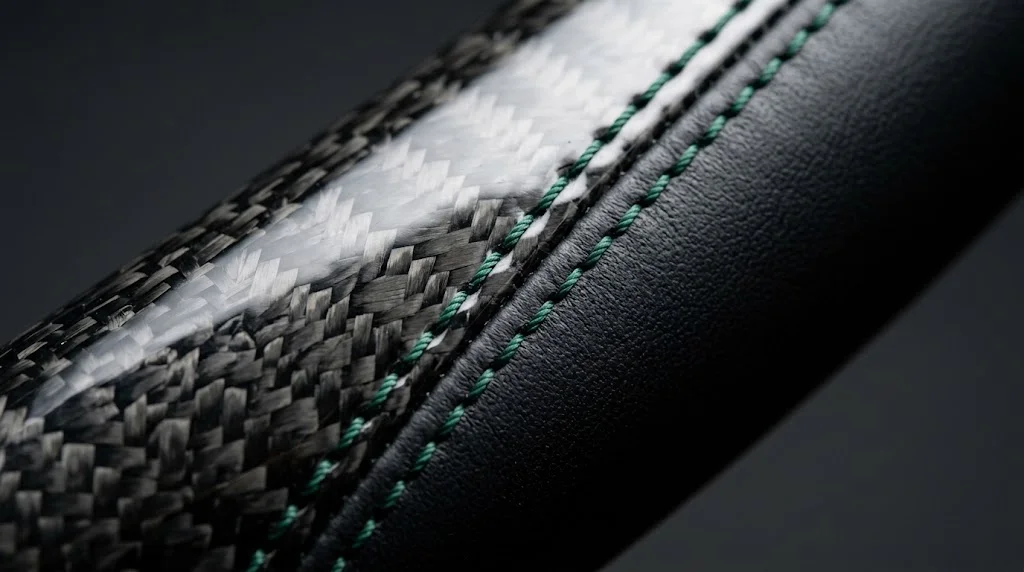
Gloss woven carbon shows the weave along the upper and lower rim. It reflects cabin light and suits a car with gloss trim panels elsewhere, though it asks for an occasional wipe.
Smooth black Nappa is the closest match to the covering BMW fits itself. It is the softest option over a long drive and the easiest surface to keep clean.
Perforated Nappa keeps the palms dry on a warm afternoon. The perforated section usually stays on the side grips, leaving the upper rim plain.
Alcantara returns the firmest grip and the least reflection. It gathers oils from bare hands, so a soft brush every few weeks keeps the nap alive.
| Covering | How it feels | Care | Suits |
|---|---|---|---|
| Gloss woven carbon | Bright, reflective weave | Microfibre wipe | Cars with gloss trim |
| Smooth black Nappa | Softest of the four | Damp cloth | Long-distance touring |
| Perforated Nappa | Cool and dry | Balm twice yearly | Warm climates |
| Alcantara grips | Firmest grip | Brush occasionally | Spirited driving |
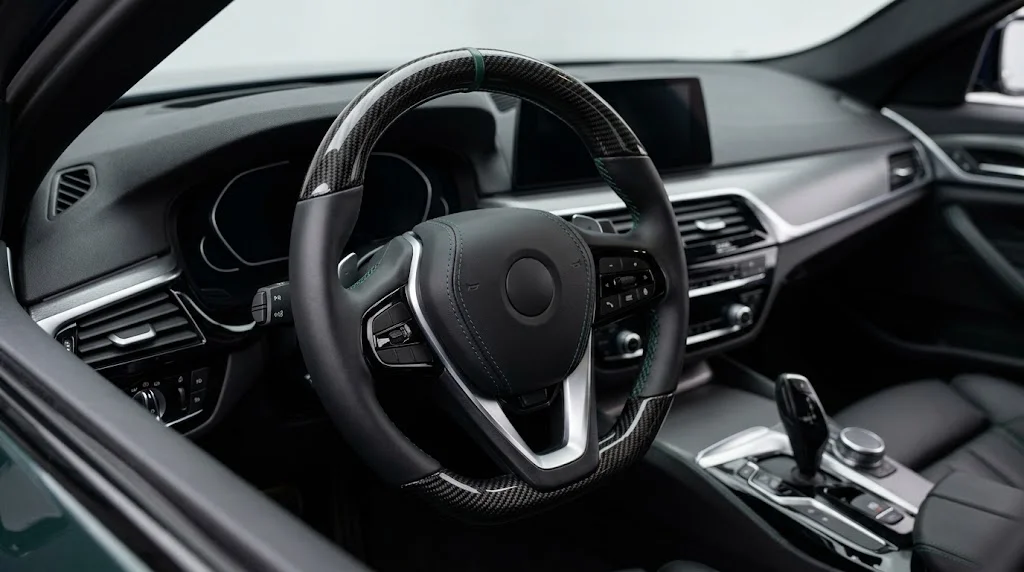
Start with the chassis number and the full option list. Add a daylight photograph of the wheel face and one of its rear with the airbag removed. Whether a BMW Alpina steering wheel fits your car turns on those details rather than on the model name.
Two cars built a year apart can carry different clusters. The photographs show us the spoke profile, the cluster and the connector shape. We cut nothing until the match is confirmed, and we will ask for a clearer picture rather than guess.
A new covering should not cost you a working switch. Our builds reuse the frame and the wiring already fitted to your car.
| Function | Typical outcome |
|---|---|
| Airbag | Original module normally reused; cover shaped to suit it |
| Multifunction buttons | Retained when the original button frame is reused |
| Paddle shifters | Retained on cars that have them; cut-outs set at order |
| Heated rim | Depends on the heating element and trim; confirm first |
| Driver assistance | Depends on the hands-on detection in the original wheel |
The heating mat and the hands-on sensor sit behind the rim. Each needs its own photograph, and neither can be judged from the front face.
Rebuilding your own wheel keeps the electronics exactly as the factory assembled them. The frame, the loom and the paddles stay standard, which is the safer route on a newer car.
A newly made core is the other option, and it leaves your original wheel in the garage. This suits a car that must return to standard, or an owner who plans to sell. On the earlier B3 and B5 models, used wheels appear often enough that a donor build can cost less.
An airbag sits at the centre of this work, so give it to someone qualified. Isolate the battery and let the car power down fully before loosening fasteners. Follow BMW procedure for the base platform rather than a general guide found online. Rest the module on something soft, and tighten the centre fastener to the figure in the workshop manual. Nothing else should be trusted for that number.
A short drive afterwards will show whether the rim is centred. Check the horn, every button and the paddles in turn. If a warning lamp stays lit, the car needs a scan before further driving.
Warranty questions follow any modification. An aftermarket steering wheel does not automatically void a vehicle warranty under U.S. federal warranty law, but warranty coverage can still depend on whether the modification caused the specific failure being claimed.
Whether coding is needed depends on the parts your car keeps. Reuse the factory module, the loom and the vehicle-specific hardware, and the car may accept the new wheel without extra work. A module from another build can behave differently.
Because that differs between cars, coding is described here as a possible step. A chassis number and photographs of both electronic units are enough for us to say whether a workshop visit looks likely.
Faults on these cars seldom begin with the covering. They begin with fitment. A wheel from a neighbouring platform often carries the same badge but a different button cluster. A heated rim added to a car that never had one leaves an unused plug and a switch with nothing to do. The reverse case appears just as often. Driver assistance reads hardware inside the factory rim, so swapping it can raise messages. A cover shaped for one airbag arriving on a car with another is the quiet cosmetic failure. The checks above clear every case.
A retrimmed rim changes the small things first. The grip feels different for a few journeys, and most owners adjust within a week of ordinary driving. In a quiet car, the change is more noticeable than it would be in a noisier cabin.
Upkeep is easy when it is regular. A microfibre cloth and a mild soap keep carbon and leather looking right, and a soft brush lifts the nap on Alcantara. Keep solvents away from the stitching.
Sometimes, where the platform and cluster match. Every car is checked on its own merits before anything is ordered.
Where the factory fitted a heated rim, usually yes. It depends on matching the matting, which we confirm from photographs.
Only for a donor build. A newly made core leaves your factory wheel with you.
On cars that have them, yes. Tell us which type is fitted and we will confirm before anything is made.
The workshop needs ten to fifteen working days, and shipping takes a further fifteen to twenty. Allow twenty-five to thirty-five days from order to arrival.
A photograph of the seats and door cards in daylight lets us match the thread as closely as the range allows.
The original module is reused, and the cover is shaped around it. That is why photographs of the rear are requested before an order is accepted.
Yes, with a newly made core. A donor build uses your own wheel, and it returns with the new covering fitted.
Every rim leaves our Guangzhou workshop built for one car. Thirteen or more years of design, engineering and manufacturing sit behind the patterns we offer, so nothing is cut until your chassis is confirmed. You decide the material, the stitching and the rim shape. Orders ship tracked worldwide, carry a three-year warranty, and can be returned within thirty days through an RMA request.
A pair of nearby guides is worth reading first. The X3 guide covers the SUV and the same covering choices in a taller cabin. The 4 Series guide deals with the coupé on the platform under the B3 and B4. The full range sits in the shop, and the BMW pages are the brand listing, the Alpina page and the 7 Series listing.
Photograph the wheel where it sits, add the chassis number and the option list, and send them across. We will reply with a confirmed build and a date before we make your BMW Alpina steering wheel. One wheel in the catalogue suits the larger Alpina models. It is the forged carbon wheel listed for the G12 and related BMW platforms, and the covering can be changed to leather at order.
Background reading is on hand. The installation guide steps through battery and airbag work, and the FAQ covers what owners ask most. The about page shows where these rims are built. Fitment and delivery questions can go to the inquiry form, or through the contact page. Delivery windows sit in the shipping policy, and returns follow the return and refund policy. American warranty law is set out in 15 U.S.C. 2304, and air bag requirements appear in 49 CFR 571.208.
Carbon fiber, Alcantara or leather on a BMW rim? How the three coverings differ on grip, heat and wear, and where each one belongs on a G20, an M3 or an X3.
Read More →How to specify a custom steering wheel for a BMW Z4, from the E85 and E89 to the G29: fitment, coverings, coding and what to check before you order.
Read More →How to specify a custom steering wheel for a BMW X3, from the E83 and F25 to the G01 and X3 M: fitment, coverings, coding and what to check before ordering.
Read More →