
The BMW 8 Series Custom Steering Wheel Guide
How to specify a custom steering wheel for a BMW 8 Series, from the G14, G15 and G16 to the earlier F92 and F93: fitment, materials and installation.
Read More →Guide · 10/9/2026
How to specify a custom steering wheel for a BMW 4 Series, from the F32, F33 and F36 to the G22, G26 and M4: fitment, finishes, coding and installation.
The 4 Series sits between the practical 3 Series and the grand touring 8 Series. Most owners run one as a daily car that still has to entertain on an empty road. That mixture shows up at the wheel. The rim collects the wear of every commute, and the driver feels it long before the rest of the cabin looks tired. A custom BMW 4 Series steering wheel renews the one surface your hands never leave.
The 4 Series spans two generations, and the wheel changed between them. Locate your car in the table, then let us confirm the detail before anything is specified.
| Chassis | Model and typical years | What usually matters |
|---|---|---|
| F32 / F36 | 4 Series Coupé and Gran Coupé, 2014 to 2020 | Earlier button frame, fewer wheel variants |
| F33 | 4 Series Convertible, 2014 to 2020 | Usually the same family as the coupé |
| F82 / F83 | M4 Coupé and Convertible, 2014 to 2020 | Thicker rim, different spoke trim |
| G22 / G26 | 4 Series Coupé and Gran Coupé, 2021 onwards | Newer button cluster and airbag cover |
| G82 / G83 | M4, 2021 onwards | M-specific frame with its own trim options |
The chassis code settles more than the badge does. Cars change hands with wheels from other trims, so the model on the boot lid is only a starting point. The option list and a pair of photographs do the rest of the work.
A 4 Series covers a great deal of ordinary mileage. Motorway running polishes the rim at nine and three long before the seats show anything. That shine is the first thing owners notice while cleaning the interior. Renewing the surface your hands live on is a smaller job than replacing the car, and it changes how every journey feels.
Specification is the second reason. Buyers who ordered a standard wheel often want the thicker rim and the flatter lower section they associate with the quicker versions. Because each BMW 4 Series steering wheel is built to your car, shape and covering are chosen at order. Silver-grey stitching, a twelve o'clock mark and a perforated grip section are the choices most owners settle on.
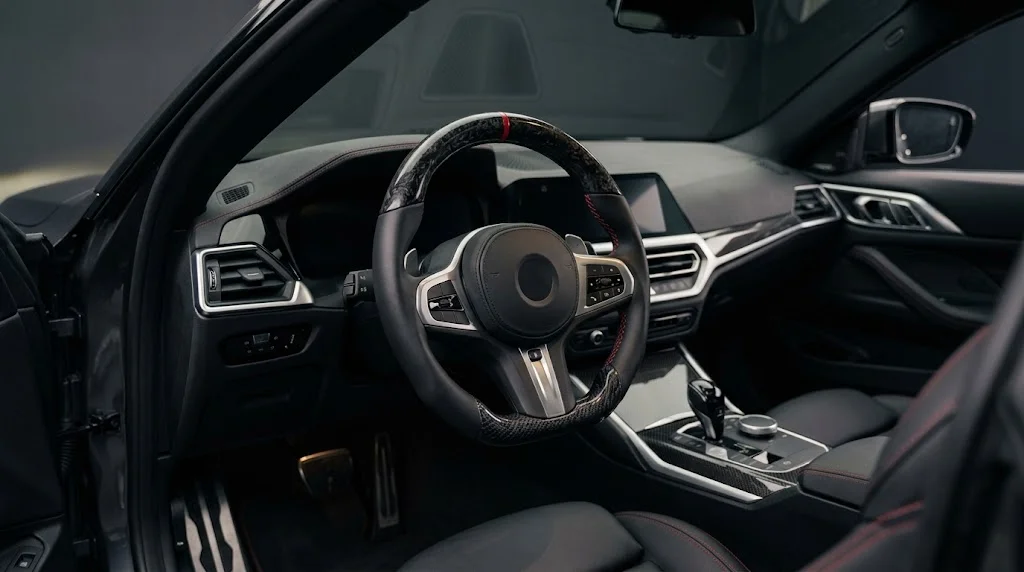
Four finishes cover almost every 4 Series build we make. Each BMW 4 Series steering wheel starts from the way the car is used rather than from a photograph.
Gloss woven carbon shows the weave clearly along the top and lower rim. It reflects cabin light and lifts a dark interior, and it asks for a wipe every week or two. Owners who garage the car tend to choose it.
Smooth black Nappa is the closest match to the covering BMW fits itself. It is the easiest surface to keep, and a damp cloth deals with most marks. The grain hides everyday handling well.
Perforations let air reach the palms, which keeps the grip consistent on a warm afternoon. The perforated section usually stays on the side grips, leaving the upper rim plain.
Alcantara returns the firmest grip and the least reflection. It gathers oils from bare hands, so a soft brush every few weeks keeps the nap alive. Drivers who enjoy a good road accept that.
| Finish | How it feels | Care | Suits |
|---|---|---|---|
| Gloss woven carbon | Bright, reflective weave | Microfibre wipe | Garaged cars |
| Smooth black Nappa | Softest of the four | Damp cloth | Everyday use |
| Perforated Nappa | Cool and dry | Balm twice yearly | Warm climates |
| Alcantara grips | Firmest grip | Brush occasionally | Spirited driving |
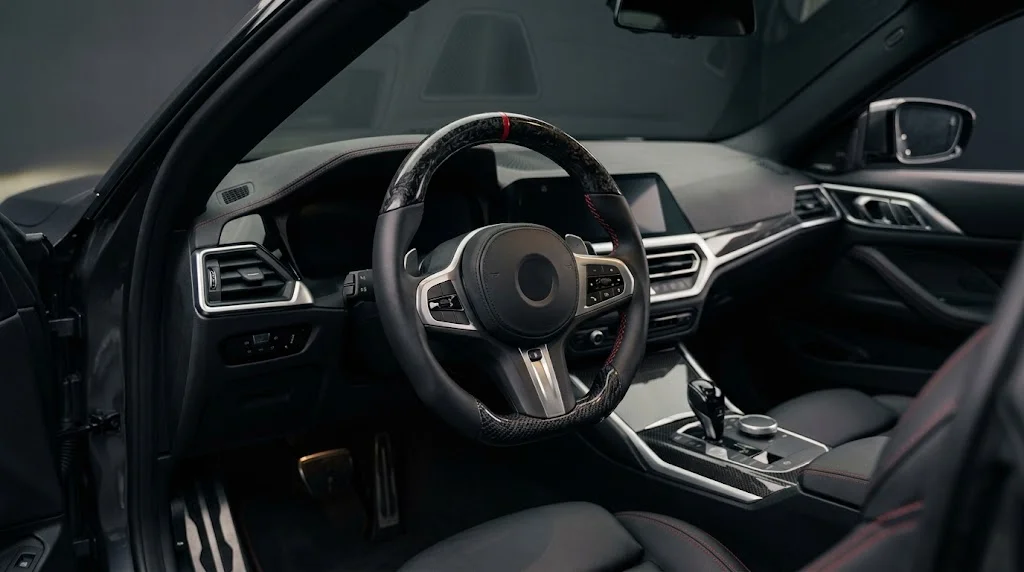
Four items answer almost every enquiry. Send the chassis number and the full option list. Add a daylight photograph of the wheel face and one of its rear with the airbag removed. Whether a BMW 4 Series steering wheel fits your car turns on those details rather than the trim badge.
Two cars of the same year can leave the factory with different button frames. The photographs show us the spoke profile, the button cluster and the connector shape. We cut nothing until the match is confirmed, and we will ask for a clearer photograph rather than assume. If the car has changed hands, the option list matters more than the paperwork.
A better finish should never disable a switch that already works. Our builds reuse the frame and the wiring fitted to your car.
| Function | Typical outcome |
|---|---|
| Airbag | Original module normally reused; cover shaped to suit it |
| Multifunction buttons | Retained when the original button frame is reused |
| Paddle shifters | Retained on cars that have them; cut-outs set at order |
| Heated rim | Depends on the heating element and trim; confirm first |
| Driver assistance | Depends on the hands-on detection in the original wheel |
The heating mat and the hands-on sensor both sit behind the rim. Each needs its own photograph. Neither can be judged from the front face, and a guess here is the most common cause of a delay.
Rebuilding your own wheel leaves the electronics exactly as BMW assembled them. The frame, the loom and the paddles stay standard, which is the safer route on a newer G22. Your factory wheel then returns with a new surface rather than being replaced.
A newly made core is the other option, and it keeps your original wheel in the garage. This suits a leased car that has to go back to standard, or an owner planning to sell. On an F32, used wheels are common enough that a donor is often the cheaper route.
An airbag sits in the middle of this job, so give the work to someone qualified. Isolate the battery and let the car power down fully before loosening fasteners. Follow BMW procedure for your chassis rather than a general guide found online. Rest the module on something soft, and tighten the centre fastener to the figure in the workshop manual. Nothing else should be trusted for that number.
Take the car for a short drive and check that the rim sits centred. Work through every button, the paddles where fitted, and the horn. A warning lamp that stays on means the car should be read before further driving. Mention any previous coding for a different wheel, because that history can matter.
Warranty questions follow any modification. An aftermarket steering wheel does not automatically void a vehicle warranty under U.S. federal warranty law, but warranty coverage can still depend on whether the modification caused the specific failure being claimed.
Coding depends on the car rather than the finish. Where the factory module, the loom and the vehicle-specific parts are reused, further coding may not be needed. A module from another generation is a different case, and the control unit may then have to learn what is present.
Because that varies between cars, we describe coding as a possible step rather than a certainty. Send the chassis number with images of both electronic units and we will say whether a workshop visit looks likely.
Faults on these cars rarely come from the covering. They come from fitment. A wheel taken from a neighbouring generation often shares the badge but not the button frame. A heated rim on a car that never had one leaves a spare plug and a control with nothing to do. The reverse case appears just as often. Driver assistance depends on sensing hardware inside the factory rim, so replacing it can raise messages. A cover shaped for an M airbag arriving on a standard car is the quiet cosmetic failure. The checks above clear every case.
No. The two generations use different frames and connectors, so each car is checked on its own merits.
Where the factory fitted a heated rim, usually yes. It depends on matching the matting, which we confirm from photographs.
Only for a donor build. A newly made core leaves your factory wheel with you.
On cars that have them, yes. Tell us which type is fitted and we will confirm before anything is made.
Building a wheel takes ten to fifteen working days, and shipping adds a further fifteen to twenty. Plan for twenty-five to thirty-five days between order and arrival.
Not in ordinary driving. It sits at six o'clock and stays out of the way.
Every rim leaves our Guangzhou workshop built for one car. More than 13 years of design, engineering and manufacturing sit behind the patterns we offer, so nothing is cut until your chassis is confirmed. You decide the material, the stitching and the rim shape. Orders ship tracked worldwide, carry a three-year warranty, and can be returned within thirty days through an RMA request.
A pair of nearby guides is worth reading before you decide. The 8 Series guide covers BMW's long-distance coupé and the same finishes in a larger cabin. The 2 Series guide deals with the smallest rear-drive car in the range. The full range sits in the shop, and the BMW pages are the brand listing and the 4 Series page.
Photograph the wheel where it sits, add the chassis number and the option list, and send them across. We will reply with a confirmed build and a date before we make your BMW 4 Series steering wheel. The catalogue holds two entries for this platform. The first is the nappa leather wheel listed for the F32, F33, F36, F82 and F83. The second is the carbon fibre wheel covering the G22, G23, G26, G82 and G83.
Background reading is on hand. The installation guide steps through battery and airbag work, and the FAQ covers what owners ask most. The about page shows where these rims are built. Fitment and delivery questions can go to the inquiry form, or through the contact page. Delivery windows sit in the shipping policy, and returns follow the return and refund policy. American warranty law is set out in 15 U.S.C. 2304, and air bag requirements are published in 49 CFR 571.208.
How to specify a custom steering wheel for a BMW 8 Series, from the G14, G15 and G16 to the earlier F92 and F93: fitment, materials and installation.
Read More →How to specify a custom steering wheel for a BMW 2 Series, from F22 and F87 to the G42 and G87: fitment checks, materials, installation and coding.
Read More →How to specify a custom steering wheel for a BMW X5 G05 or 7 Series G70: fitment checks, the factory functions you can keep, materials, installation and coding.
Read More →